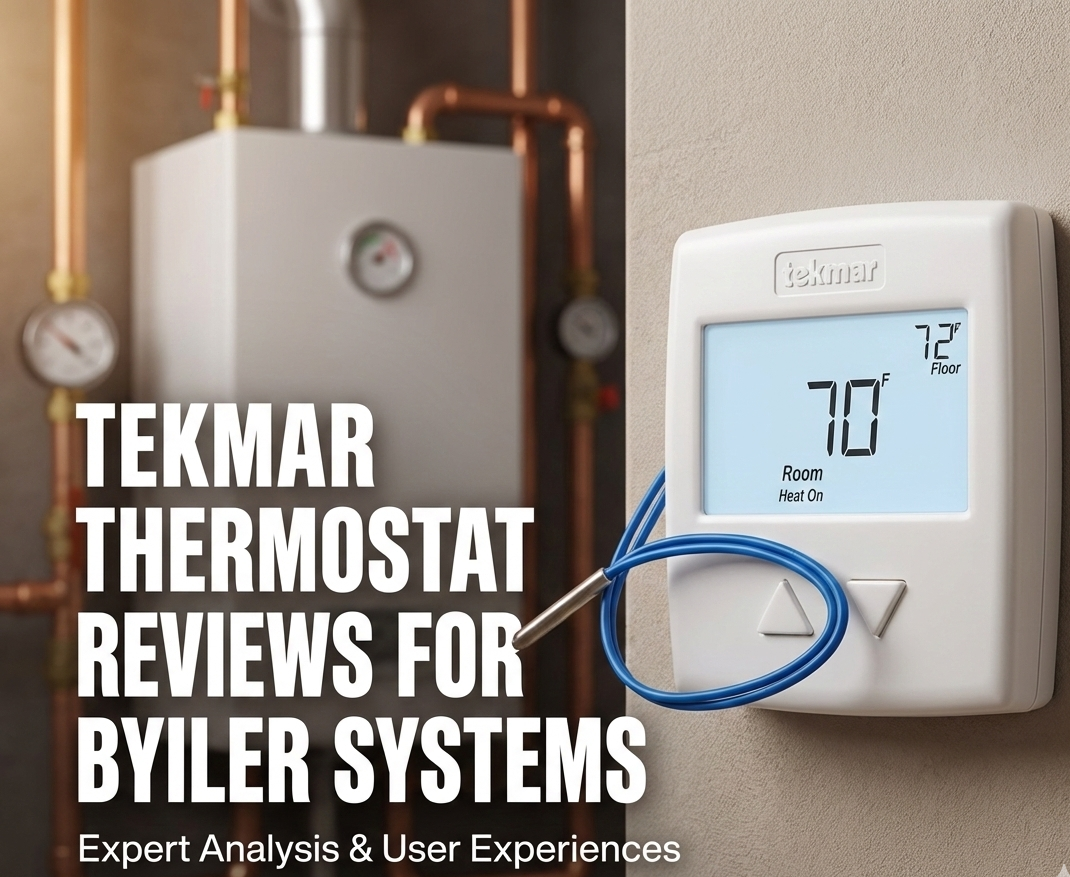
Tekmar Thermostat Reviews for Boiler Systems: Precision Hydronic Control
If you own a home with hydronic heating—whether it’s radiant floor loops, baseboards, or cast-iron radiators—you have likely realized that standard “smart” thermostats struggle to keep up. The thermal lag of water-based systems often leaves standard thermostats confused, leading to overheating, undershooting, and inefficient boiler cycling.
Enter Tekmar. Unlike consumer-grade gadgets found in big-box stores, Tekmar controls are engineered specifically for the thermodynamics of boiler systems. They don’t just turn heat on and off; they manage energy delivery with industrial precision. For a detailed head-to-head between their two flagship models, see our dedicated Tekmar 561 vs 519 radiant floor control comparison.
In this extensive guide, we are reviewing the best Tekmar thermostats for boiler systems, breaking down their industrial-grade features like Pulse Width Modulation (PWM) and Outdoor Reset, and comparing them against popular alternatives. If you are tired of uncomfortable temperature swings in your radiant heated home, this review is for you.
Why Your Boiler Needs a Specialist, Not a Generalist
Most thermostats are designed for forced-air furnaces. A furnace heats air quickly, and when it turns off, the heat stops almost instantly. Boilers are different. They heat water, which retains heat for a long time. If you use a standard thermostat, the residual heat in your radiators or floor slab continues to radiate long after the thermostat clicks off. This is called “overshoot,” and it is the primary reason boiler owners complain about uncomfortable temperature swings despite having a perfectly functional heating system.
To understand why this matters at the control level, it helps to understand what a thermostat fundamentally does — sense temperature, compare it to a setpoint, and command equipment. The difference with Tekmar is not the basic definition but the sophistication of the command logic. A standard thermostat sends a binary on/off signal. A Tekmar analyzes heating load, thermal mass, and outdoor conditions before making its decision. For a deeper technical walkthrough of the sensing and switching mechanisms involved, our guide on how thermostats work covers thermistors, relays, and the microcontroller logic that both standard and premium thermostats share.
Tekmar thermostats solve this using algorithms designed for high-mass systems. Before diving into the specific model reviews, it is vital to understand that upgrading to a Tekmar isn’t just about changing the interface—it is about changing the logic of how your home is heated.
Important: Boiler Type Matters for Thermostat Selection
Not all boilers are the same, and your thermostat choice must account for the type of hydronic system you have. High-mass cast-iron boilers hold enormous amounts of hot water and take hours to cool down — these benefit most from Tekmar’s PWM logic. Modern modulating condensing boilers adjust their own water temperature based on outdoor reset, but still benefit from a thermostat that communicates load conditions accurately rather than crude on/off demands. Electric boilers heat water instantly but can be damaged by short cycling if the thermostat does not enforce minimum run times. Before investing in any hydronic thermostat, confirm that your specific boiler and zone valve configuration is compatible — our thermostat-furnace compatibility guide walks through the verification process step by step, including the unique considerations for hydronic systems.
However, if you are currently renting and cannot replace the entire control logic of a system, you might want to look at smart thermostats suited for rental properties that are less invasive to install and can be removed without modifying the boiler wiring.
The Physics Problem: Why Standard Thermostats Fail on Boilers
To appreciate what Tekmar solves, you must understand the fundamental mismatch between standard thermostat logic and hydronic heating physics. This is not a matter of brand preference — it is a matter of control theory.
Thermal Mass and Response Lag
A forced-air furnace blows 120°F air through ducts, and within minutes of the fan starting, you feel warmth. When the thermostat satisfies and shuts off the furnace, the air in the room cools down within minutes. The thermostat’s temperature sensor registers these changes quickly — within 2-5 minutes — so its control algorithm works as designed: call for heat, sense the temperature rise, shut off when the setpoint is reached, and repeat as the room cools.
A radiant floor slab operates on a completely different time constant. The boiler fires and sends 140-180°F water through tubing embedded in concrete. It takes 30-90 minutes for that heat to conduct through the concrete and begin warming the room air. When the thermostat shuts off the boiler, the concrete slab — now heated to 80-85°F — continues radiating heat into the room for another 2-4 hours. The thermostat’s sensor registers the rising temperature long after the boiler has stopped firing, which confuses its control algorithm. The result: the thermostat calls for heat, waits, registers no immediate change, calls for more heat, and then watches helplessly as the room temperature overshoots the setpoint by 3-5°F while the slab releases its stored energy.
This is the control problem that Tekmar’s PWM and cycle rate settings specifically address. They account for the thermal mass in the system and predict future temperature changes rather than simply reacting to current readings. For homeowners trying to understand whether their existing thermostat can be upgraded, our guide on how to tell if your thermostat can be upgraded covers the wiring and compatibility checks specific to boiler installations.
Cast Iron Radiators: Another Challenge
If your home has standing cast-iron radiators rather than in-floor tubing, the control problem is similar but with slightly different characteristics. Radiators have substantial thermal mass (each section weighs 20-40 pounds of iron), so they also continue radiating heat long after the boiler shuts off. However, unlike floor slabs, radiators heat the air more directly through convection, so the response time is shorter — typically 20-45 minutes of residual heat rather than 2-4 hours. Tekmar thermostats let you specify “Radiator” as the terminal unit type, which adjusts the PWM cycle timing to match this intermediate thermal mass profile.
Baseboard Convectors: The Easiest Hydronic Case
Fin-tube baseboard convectors are the closest hydronic equivalent to forced air. They contain relatively little water volume, and the aluminum fins dissipate heat quickly into the room air. The thermal lag is typically 10-20 minutes — still longer than a forced-air furnace but manageable with a standard thermostat’s cycle rate adjustments. Tekmar still provides value here through outdoor reset integration and zone synchronization, but the comfort improvement is less dramatic than with radiant floors or cast-iron radiators.
1. Tekmar 561 WiFi Thermostat: The Best of Both Worlds

Top Pick for Modern Boiler Control
Best For: Homeowners who want professional hydronic control with mobile app convenience.
Check Price on AmazonThe Tekmar 561 is arguably the most significant release from Tekmar in the last decade. Historically, you had to choose between a “dumb” thermostat that handled boilers perfectly or a “smart” thermostat that handled boilers poorly. The 561 bridges that gap by combining WiFi connectivity and app control with genuine hydronic intelligence.
Performance & Features
The 561 supports a single stage of heating and one stage of cooling (or two stages of heating), making it suitable for homes that pair a boiler with a separate central air conditioning system. However, its magic lies in its settings. It allows you to select the terminal unit type: Radiator, Baseboard, or High Mass Floor. Once selected, the thermostat automatically adjusts its cycles per hour and minimum run times to match that specific physics profile — compensating for the thermal lag characteristics described above.
It also features Auto-Cycling. Unlike a Honeywell T9 which uses standard per-hour cycle counts that work for forced air but create chaos in concrete, the Tekmar 561 calculates the exact amount of “on” time needed to maintain the room temperature without overshooting. It is not guessing — it is doing load calculations based on observed temperature response curves over multiple heating cycles.
The 561 also supports an auxiliary floor sensor input. This allows you to embed a temperature probe directly in the floor slab or under tile, giving the thermostat two data points: room air temperature and floor surface temperature. This dual-sensor approach enables you to set both a maximum floor temperature (protecting hardwood, engineered wood, and laminate from warping at temperatures above 85°F) and a minimum floor temperature (ensuring bathroom tile is always warm to bare feet regardless of air temperature). No consumer smart thermostat offers this capability, which is why comparing the 561 to a Nest or Ecobee on feature count alone misses the point entirely.
The WiFi Experience
The Watts Home app (Tekmar is owned by Watts) is utilitarian but effective. It allows for remote temperature changes, scheduling, and energy monitoring. It isn’t as polished as the interface you’d find when comparing Nest vs. Ecobee, but it offers far more technical data regarding your heating cycles — including cycle history, floor temperature trends, and outdoor reset activity logs. For the hydronics enthusiast who wants to understand exactly what their system is doing, this data is more valuable than a sleek interface.
For an explanation of how WiFi thermostats communicate with cloud servers and mobile apps — the same infrastructure the 561 uses — our smart thermostat connectivity guide breaks down the network architecture, command latency, and local vs. cloud processing tradeoffs that affect every WiFi-enabled thermostat regardless of brand.
Pros
- True boiler logic (PWM and Cycle settings calibrated for hydronic thermal mass).
- Supports Floor Sensor inputs (protects hardwood, engineered wood, and laminate from heat damage).
- WiFi connectivity with remote app control via Watts Home.
- Modern touchscreen design that looks appropriate in contemporary homes.
- Outdoor temperature display via internet weather for virtual outdoor reset calculations.
- Terminal unit selection (radiator, baseboard, high-mass floor) automatically optimizes cycle parameters.
- One stage of cooling support for homes with separate AC systems.
Cons
- Requires a C-Wire (3-wire installation) — not compatible with older 2-wire boiler thermostat wiring without pulling new cable.
- App interface is less visually polished than consumer-grade apps from Nest or Ecobee.
- More expensive than standard programmable thermostats ($120-160 range typically).
- Setup requires navigating installer menus that assume boiler system knowledge — not intimidating for pros, but the manual uses terminology unfamiliar to many homeowners.
2. Tekmar 519 Radiant Thermostat: The Pure Specialist
Best Non-WiFi Option for Zoning
Best For: Multi-zone systems where you just want reliable temperature control without the hassle of WiFi setup for every room.
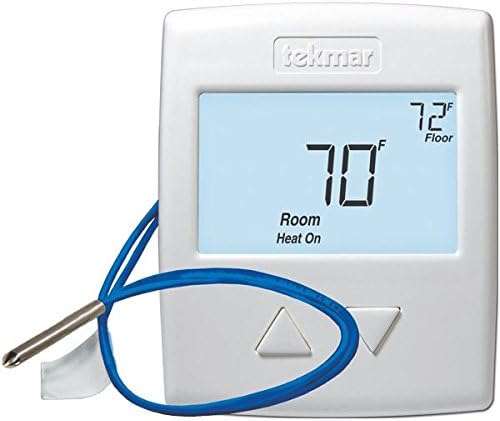
Check Price on AmazonIf you have a large home with 8 or 10 different heating zones, you probably don’t need a WiFi thermostat in every single guest bedroom or bathroom. The Tekmar 519 is the streamlined, heavy-hitting sibling of the 561 — the zone controller you install in every room while perhaps keeping a single 561 in the main living area for app-based whole-house oversight.
For a focused comparison of how these two models stack up feature by feature, our Tekmar 561 vs 519 radiant floor control comparison covers wiring requirements, PWM implementation differences, and which model makes sense for which zone in a multi-zone installation.
Simplicity Meets Science
The 519 looks deceptively simple. It has a small footprint and a clear, high-contrast display designed to be read from across a room. However, under the hood, it utilizes Pulse Width Modulation (PWM) — the same intelligent cycling technology found in the more expensive 561. This feature modulates the on/off time of your zone valves to ensure a constant floor temperature, rather than the hot/cold feeling of standard hysteresis loops that plague hydronic systems with generic thermostats.
This unit is specifically designed to work with Tekmar’s switching relays, but it maintains universal compatibility with Taco, Honeywell, Caleffi, and Argo zone valve controls — essentially any 24VAC switching relay used in residential and light commercial hydronic installations. If you are looking for a cheaper alternative for secondary rooms, you might consider checking our guide on best budget thermostats under $50, though you will sacrifice the PWM feature essential for true radiant comfort in any system with significant thermal mass.
Pros
- Incredibly compact design (fits modern aesthetics and leaves a clean wall footprint).
- Pulse Width Modulation for constant floor heat — the defining feature that separates hydronic thermostats from generic units.
- Includes slab sensor capability (protects hardwood, laminate, and engineered wood floors from heat damage).
- No batteries required — powered entirely by the 24V system, eliminating the maintenance task of annual battery replacement.
- Simple interface reduces tenant or guest confusion in multi-zone installations.
- Lower cost per zone than the 561, making whole-house zoning economically feasible.
Cons
- No WiFi (cannot control from phone, no remote monitoring, no energy usage tracking).
- Small screen might be hard to read for visually impaired users — the 561’s larger touchscreen is more accessible.
- Strictly for heating (no cooling control) — cannot manage a separate AC system.
- Limited to single-stage heating — not suitable for two-stage boiler applications without additional relay logic.
Tekmar 561 vs 519: Which Model for Which Room?
Many Tekmar installations use a combination of both models — a 561 in the primary living zone for app control and data visibility, and 519 units in secondary zones where simpler local control suffices. Here is a practical decision matrix to guide your per-room selection:
| Room / Zone | Recommended Model | Rationale |
|---|---|---|
| Main living area (living room, kitchen) | Tekmar 561 | WiFi control for scheduling changes; energy data visibility; the room you interact with most benefits from app access. |
| Master bedroom | Tekmar 561 | App-based nighttime setback adjustments without walking to the thermostat; floor minimum temperature for bathroom comfort. |
| Secondary bedrooms | Tekmar 519 | Set schedule once, rarely needs adjustment; lower per-unit cost for multiple rooms. |
| Guest bathroom | Tekmar 519 | Floor minimum ensures warm tile; no need for WiFi in a room used intermittently. |
| Basement / rec room | Tekmar 519 | Large slab benefits from PWM; schedule typically fixed; cost savings over 561. |
| Garage / workshop (heated slab) | Tekmar 519 | Floor protection sensor critical; WiFi unnecessary in a utility space. |
| Home office (daily occupied) | Tekmar 561 | Occupant benefits from app-based override when working late or on weekends. |
For a typical 2,500 sq ft home with four heating zones, a common configuration is one 561 in the main living zone, a second 561 in the master suite, and two 519 units in secondary bedrooms or the basement. This balances cost with functionality, putting WiFi where it provides daily value and saving money where a simple programmable suffices.
Comparison: Tekmar vs. The Competition
How does a dedicated hydronic control stack up against the popular smart home giants? If you are torn between a Tekmar and a Nest, or comparing Ecobee vs Honeywell Home for your boiler, this table clarifies the differences in the areas that matter most for hydronic performance.
| Feature | Tekmar 561 | Google Nest Learning | Ecobee Smart Premium |
|---|---|---|---|
| Control Logic | PWM / Hydronic Specific | Time-to-Temp (AI Learning) | Threshold / Differential |
| Slab Sensor Input | Yes (Included support) | No | No |
| Boiler Protection | High (Short cycle prevention) | Low (Can short cycle boilers) | Medium |
| Cycle Rate Adjustment | Configurable by terminal type | Automatic (forced-air optimized) | Configurable (limited) |
| Power Requirement | C-Wire Required (3-wire) | Power Stealing (Often fails on 2-wire boiler circuits) | C-Wire (PEK included but not ideal for boiler wiring) |
| App Ecosystem | Watts Home (Basic, hydronic-focused) | Google Home (Advanced, general purpose) | Ecobee / HomeKit (Advanced, general purpose) |
| Floor Temperature Protection | Yes (hi/lo limits via slab sensor) | No | No |
| Outdoor Reset | Virtual (WiFi weather) or wired sensor | None | None (weather display only) |
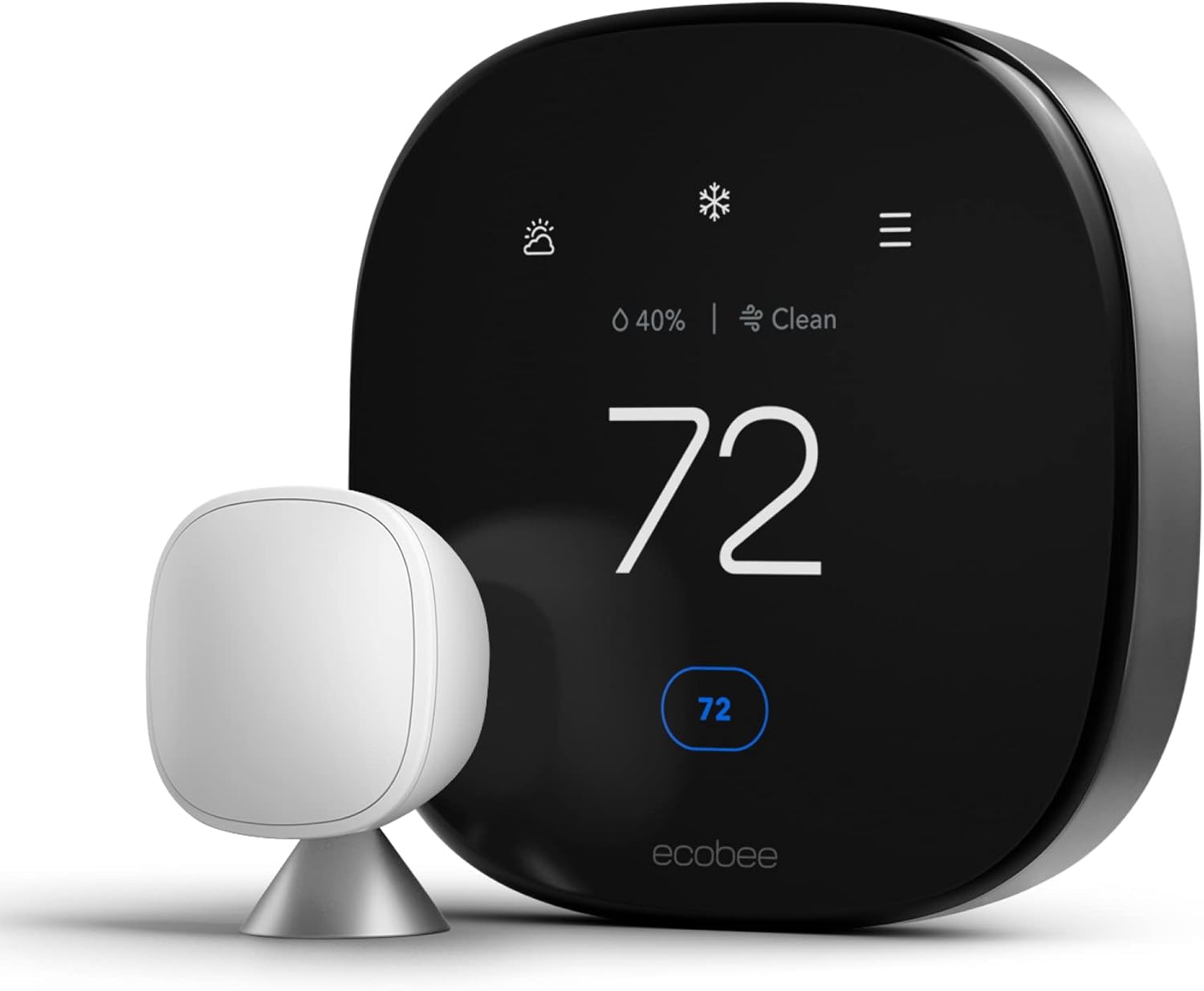
The Verdict: If you care about smart home integrations like voice control, multi-platform compatibility, and slick interfaces with features like adaptive learning and geofencing, check out our review of the Ecobee Smart Thermostat Premium — it is the most technically sophisticated consumer thermostat available, and it includes radar-based occupancy sensing that no other brand currently matches. However, if your priority is the longevity of your boiler, the elimination of temperature swings, and the protection of expensive flooring, Tekmar wins on physics alone. The smart home features are nice; the hydronic control features are essential.
Power Stealing Warning for Nest Users
Google Nest’s “power stealing” technique draws a small current through the heating circuit to charge its internal battery when no C-wire is present. This works reliably on forced-air furnaces with standard 24V control boards. However, many boiler zone valve controls and switching relays present different electrical characteristics — higher impedance or different voltage thresholds — that cause the Nest’s power stealing to fail intermittently. The symptom: the Nest works fine for days, then suddenly goes offline or displays a low-battery warning despite the boiler running. Tekmar’s requirement for a dedicated C-wire eliminates this entire class of reliability problems. For more on battery vs. hardwired configurations, our battery-powered smart thermostat guide covers the tradeoffs in detail including the C-wire workarounds available for different system types.
Deep Dive: Understanding Tekmar’s Unique Features
To truly appreciate these reviews, we must unpack the technology that justifies the price tag. Unlike standard thermostats that operate like a simple light switch — on or off, all or nothing — Tekmar operates like a dimmer. It modulates energy delivery to match the actual heating load of the space moment by moment.
1. Pulse Width Modulation (PWM)
Standard thermostats wait for the room to drop 1 degree below the setpoint, turn on the boiler, wait for it to rise 1 degree above, and turn off. With radiant floors, the floor is still hot when the thermostat turns off, so the room continues to heat up (overshoot). Then, it takes hours to cool down. The occupant experiences a cycle: cold feet, warm feet, hot feet, cold feet again — a 3-5°F swing that repeats every few hours.
Tekmar’s PWM calculates the heating load continuously. If the room needs 50% heat to maintain temperature, the Tekmar might turn the zone valve on for 15 minutes and off for 15 minutes repeatedly — a 50% duty cycle. This keeps the floor at a perfectly constant warm temperature, rather than cycling between hot and cold. The result is a room that feels consistently warm without noticeable temperature swings, often to within ±0.5°F of setpoint compared to ±2-3°F with a standard thermostat on the same hydronic system.
The technical implementation: Tekmar’s microcontroller continuously samples the thermistor (temperature sensor), calculates the error between actual and setpoint temperature, and applies a proportional-integral (PI) control algorithm to determine the correct duty cycle. Over multiple cycles, the integral term eliminates steady-state error — meaning the system learns the exact heat loss rate of the room and compensates without the persistent offset errors that plague simple proportional-only controls.
2. Slab Sensing (Floor Protection)
Both the 561 and 519 support auxiliary sensors. You can embed a sensor in the floor — typically a 10k ohm NTC thermistor probe in a protective sleeve installed in the concrete or thin-set mortar during floor construction. This allows you to set a Maximum Floor Temperature (crucial for protecting expensive hardwood or laminate from warping — most wood flooring manufacturers specify a maximum surface temperature of 80-85°F) and a Minimum Floor Temperature (crucial for bathrooms where you always want warm tiles, regardless of the air temperature, typically 75-80°F for barefoot comfort).
Without slab sensing, an air-temperature-only thermostat can call for enough heat to satisfy the room’s heat loss that the floor surface reaches 90-100°F — hot enough to damage wood flooring and uncomfortable for bare feet. The slab sensor acts as a safety governor, overriding the air temperature demand when floor temperatures approach damaging levels.
This is a capability completely absent from consumer smart thermostats, and it is the single most important feature for homes with wood or engineered wood flooring over radiant heat. For more on how remote sensors enable multi-point temperature monitoring in homes, our guide to thermostat remote sensors covers the technology and placement strategy — though note that the consumer sensors from Ecobee and Honeywell measure air temperature and occupancy, not embedded floor temperature, which is a fundamentally different application.
3. Outdoor Reset (Virtual or Wired)
Traditional boiler controls run the water at 180°F regardless of whether it is 50°F or -10°F outside. This is enormously inefficient. On a 50°F day, the building’s heat loss is a fraction of what it is at -10°F, yet the boiler is delivering the same water temperature. The result: overheating, constant thermostat cycling, and fuel waste.
Tekmar pioneered “Outdoor Reset,” which lowers the boiler water temperature on milder days. The concept: as outdoor temperature rises, the boiler water temperature is automatically reduced according to a programmed heating curve. At 50°F outside, the boiler might only need to deliver 100°F water to maintain comfort. At -10°F, it ramps to the full 180°F. This eliminates overheating on mild days and dramatically reduces fuel consumption — typical savings range from 10-20% on annual heating bills compared to a fixed-temperature boiler control.
The 561 implements outdoor reset virtually using WiFi weather data — it knows the current outdoor temperature from internet weather services and adjusts its internal cycle algorithms accordingly. Higher-end Tekmar boiler controls (separate from the wall thermostat) use a wired outdoor temperature sensor mounted on the north side of the building for direct measurement. Both approaches significantly outperform a system with no outdoor reset at all.
For a comparison of how other brands handle sensors and multi-zone temperature management, read our analysis of Ecobee3 Lite vs Google Nest, paying attention to their remote sensor capabilities — but recognize that those sensors measure air temperature and occupancy, serving a different purpose than Tekmar’s slab sensors and outdoor reset calculations.
Installation Notes & Compatibility
Installing a Tekmar is slightly more involved than swapping out a basic Honeywell programmable thermostat. The wiring requirements are more stringent, and the installer settings menu assumes familiarity with hydronic system parameters. Here are the critical factors to verify before purchasing:
The C-Wire Requirement
Many older boiler systems only run two wires to the thermostat (Red and White). This simply completes a circuit — when the thermostat closes the connection, the boiler or zone valve activates. No common wire is present because the original mercury-bulb or bimetallic thermostats were purely mechanical switches requiring no power. The Tekmar 561 is a power-hungry WiFi device with a touchscreen display and a microcontroller running PWM calculations continuously. It cannot run on batteries. You must have a Common (C) wire — the third conductor that completes the 24V power circuit back to the transformer.
If you lack this third wire, your options are: pull new 18/3 thermostat cable from the thermostat location to the zone valve control or boiler (the preferred, permanent solution); use a plug-in 24V transformer at the thermostat location (functional but aesthetically clunky, with a visible wire running to an outlet); or use an add-a-wire accessory that multiplexes signals onto two conductors. Direct wiring is always preferred for hydronics — the add-a-wire kits can introduce signal issues on the longer cable runs common in boiler installations. For a complete walkthrough of thermostat cable types, color codes, and terminal assignments, consult our thermostat wiring guide.
Relay Compatibility
Tekmar thermostats work best with Tekmar Switching Relays or Zone Valve Controls (specifically the Tekmar 300-series relay panels), but they are universally compatible with Taco SR-series switching relays, Honeywell R8845U and R845A relays, Caleffi zone controls, and Argo switching relays. However, you must ensure your relay provides consistent 24V AC power on the R and C terminals. Some older relays, particularly those from the 1970s and earlier, may have undersized transformers that cannot supply the consistent 200-300mA that a WiFi thermostat with an always-on display demands.
A simple test: measure the AC voltage between R and C at the thermostat location while the boiler is not firing. You should see a steady 24-28VAC. If the voltage drops below 22V when the thermostat’s display backlight is active, the transformer may be undersized for a WiFi thermostat and a replacement transformer (40VA minimum recommended) should be installed. Our guide to thermostat voltage drop and transformer sizing covers this diagnostic process in detail.
Zone Valve End Switch Wiring
In systems where the thermostat controls a zone valve (rather than a circulator pump directly), the zone valve’s end switch is typically responsible for firing the boiler. This means the thermostat connects to the zone valve motor, and when the valve fully opens, its internal end switch closes to energize the boiler’s T-T (thermostat) terminals. Tekmar thermostats are compatible with this configuration, but you must wire them to the zone valve’s thermostat terminals (typically labeled TH/TH or T/T), not directly to the boiler. Incorrectly wiring the thermostat to the boiler’s T-T terminals while zone valves are also connected can bypass the end switches, causing the boiler to fire without water flow — a condition that can damage the boiler heat exchanger.
If any of this sounds unfamiliar or you are uncertain about your specific system’s wiring configuration, professional installation by an HVAC technician experienced with hydronic controls is strongly recommended. The cost of a service call is trivial compared to the cost of a cracked boiler heat exchanger caused by firing without flow.
Slab Sensor Installation
For the floor protection features to work, a slab sensor must be installed. In new construction or during a floor renovation, this is straightforward: the sensor probe (a small, sealed thermistor on a length of low-voltage wire) is embedded in the concrete when it is poured, or set into the thin-set mortar when tile is installed. In retrofit situations where the floor is already finished, installing a slab sensor is more invasive — it typically requires routing a shallow channel in the subfloor from below (accessible basement or crawlspace ceiling) or accepting that the sensor will be surface-mounted in an inconspicuous location.
If slab sensing is not feasible due to retrofit constraints, the Tekmar can still operate on air temperature alone, but you lose the floor protection features. For this reason, Tekmar thermostats deliver their maximum value in new hydronic installations or major renovations where slab sensors can be installed during construction.
Need to upgrade your system wiring or add zone controls?
Ensure you have a reliable 24V transformer and proper zone valve controls rated for your boiler’s voltage and current draw.
Shop Tekmar Relays on AmazonHow Tekmar Thermostats Integrate with the Broader HVAC System
Tekmar controls are not just wall thermostats — they are part of a larger ecosystem of hydronic control components. Understanding how the thermostat fits into the complete control architecture helps with system design and troubleshooting.
The Tekmar Control Hierarchy
In a fully integrated Tekmar system, the control hierarchy flows from the heat source outward:
- Boiler Control (Tekmar 294 or similar): Manages boiler water temperature based on outdoor reset curve, handles boiler protection (minimum return water temperature to prevent condensing corrosion in non-condensing boilers), and coordinates multiple boiler stages in commercial applications.
- Zone Manager (Tekmar Zone Valve Control 304V or Switching Relay 303): Receives heat calls from individual zone thermostats, energizes zone valves or circulator pumps, and sends a boiler demand signal to the boiler control when any zone calls for heat. Includes priority logic for domestic hot water zones.
- Zone Thermostats (Tekmar 561 or 519): The wall-mounted interface in each heated space, implementing PWM cycle logic and slab sensor monitoring at the individual room level.
While Tekmar components work together most seamlessly, the thermostats (561 and 519) are designed to interoperate with third-party zone controls and boiler relays. You do not need an all-Tekmar system to benefit from their thermostats — the intelligence resides in the thermostat itself, not in proprietary communication with other Tekmar components. For a broader understanding of how HVAC equipment components work together as a system, our explanation of what a split HVAC system is covers the equipment-side architecture that your thermostat controls.
Interaction with Cooling Systems
The Tekmar 561 supports one stage of cooling, allowing it to control a separate air conditioning system that may be entirely independent of the hydronic heating system — a common configuration in homes with boiler heat and a central AC system using separate ductwork or mini-split units. The cooling control uses standard thermostat terminals (Y and G) and does not apply PWM logic, since forced-air cooling operates on the fast thermal response that standard on/off control handles well. For homes with inverter-driven or variable-speed air conditioning, note that the Tekmar 561 will operate the system in a single-stage on/off mode — it cannot modulate compressor speed. Our guide to inverter technology in HVAC explains why variable-speed equipment benefits from communicating thermostats for full modulation capability.
Whole-Home Humidity Management
Radiant floor heating does not dry out indoor air the way forced-air furnaces do, because there is no air movement across a heat exchanger pulling moisture from the living space. However, in homes with separate central air conditioning used during summer months, whole-home dehumidification can become relevant. Tekmar thermostats do not include direct humidity control terminals (HUM or DEHUM), as those are features found on forced-air-focused thermostats. If dehumidification is important in your home during cooling season, our guide to whole-house dehumidifiers covers standalone solutions that integrate independently of your heating thermostat.
Troubleshooting Common Tekmar Thermostat Issues
While Tekmar thermostats are among the most reliable hydronic controls available, no equipment is immune to occasional issues. Here are the most common problems reported by Tekmar users and the diagnostic steps to resolve them before calling a technician.
Display Blank or Intermittently Flickering
On the 561 and 519 (both hardwired, no batteries), a blank display almost always indicates a power supply problem. The 24V supply from the transformer or zone control may be interrupted. Check: the system breaker (thermostats are often on a separate transformer circuit, not the boiler’s main power); the 3-amp fuse on the zone valve control board (a short during installation can blow this fuse instantly); and the integrity of the R and C wire connections at both the thermostat and the control board ends. A loose wire at either end can cause intermittent operation that is difficult to reproduce. For a systematic diagnostic approach to this and related power issues, our guide on thermostat low-battery and fading display failures covers the troubleshooting sequence applicable to hardwired units as well.
Room Temperature Not Reaching Setpoint
If the Tekmar calls for heat continuously but the room never reaches the target temperature, the problem is usually not the thermostat. Possible causes: an undersized boiler or zone that cannot meet the design-day heat loss; air in the radiant floor loops (air-locked loops prevent hot water flow); a failed zone valve motor that doesn’t open despite the thermostat’s call; or a circulator pump that has seized. Verify that the zone valve is physically opening (check for heat on the supply pipe downstream of the valve) and that the circulator is running (feel for vibration and check for temperature rise across the pump). Our diagnostic flowchart for thermostat not reaching set temperature works through the logical sequence of possible causes.
WiFi Disconnects (561 Only)
The Tekmar 561 uses a 2.4GHz WiFi radio, which provides better range through walls than 5GHz but can be subject to interference from other 2.4GHz devices (microwaves, Bluetooth, baby monitors, neighboring WiFi networks). If the thermostat periodically drops offline, try: relocating your WiFi access point closer to the thermostat; ensuring the thermostat is not mounted on an exterior wall with metal siding or foil-faced insulation blocking the signal; or adding a mesh WiFi node in the room adjacent to the thermostat location. Our smart thermostat connectivity guide covers 2.4GHz vs 5GHz tradeoffs and troubleshooting connection drops across all WiFi-enabled thermostats.
Incorrect Temperature Reading
If the Tekmar’s displayed temperature does not match a known-accurate thermometer placed next to it, the issue is typically placement, not calibration. Thermostats mounted on exterior walls (which are cooler in winter), near drafty windows, above heat-generating electronics, or in direct sunlight will read a temperature that differs from the room’s true average. Tekmar allows calibration offset adjustments in the installer settings menu (±5°F typically), but this only corrects for small, consistent errors — it cannot compensate for dynamic solar gain or drafts that change throughout the day. Relocating the thermostat to an interior wall away from heat sources and drafts is the proper fix. Our guide on why a thermostat shows wrong room temperature covers placement effects and calibration procedures in detail.
Are There Alternatives to Tekmar?
While Tekmar is the gold standard for dedicated hydronic control, it isn’t the only player, and certain system configurations may benefit from different approaches.
Alternative Hydronic-Focused Thermostats
- Honeywell T10 Pro: Offers decent cycle rate control through configurable cycles-per-hour settings (adjustable down to 1 CPH for high-mass radiant) and supports wireless remote sensors for multi-room temperature management. The T10 is the closest consumer-grade competitor to Tekmar in terms of hydronic awareness, though it lacks PWM and slab sensor support. See our comparison: Honeywell T9 vs T10 Pro for feature differences.
- Emerson Sensi Touch: A reliable mid-range option that runs on batteries or C-wire and handles simple boiler systems adequately. Unlike the Nest, the Sensi does not attempt power stealing — it either uses batteries or a C-wire, which makes it more reliable on boiler circuits. Read our Emerson Sensi Touch review for full details on its hydronic compatibility.
- Uponor/Schluter/Ditra-Heat Thermostats: These are proprietary controls designed specifically for electric radiant floor heating systems, not hydronic. They handle line-voltage (120V/240V) electric heating mats and cables with floor sensors for temperature limitation. They are not substitutes for Tekmar but serve the electric radiant market that Tekmar does not address. For electric systems, see our best thermostats for electric radiant floors guide.
For Line-Voltage Electric Baseboard (Not Hydronic)
If you have electric baseboard heating (high voltage) rather than a hydronic boiler, Tekmar is NOT for you. Installing a low-voltage Tekmar on a line-voltage circuit is a serious fire and equipment damage risk. You need a line-voltage thermostat specifically rated for 120V or 240V operation. The Mysa and Sinopé brands dominate this category. Check out our Mysa smart thermostat review or the comparison of Mysa vs Sinope for electric baseboard solutions. If you are unsure whether your system is line-voltage or low-voltage, our 2-minute line-voltage vs low-voltage wiring test provides a definitive answer using only visual inspection.
For Those Considering a DIY Smart Approach
Some technically inclined homeowners attempt to achieve hydronic-optimized control using a smart thermostat with configurable cycle rates and differential settings. While possible in theory, this approach requires understanding your system’s thermal characteristics and manually tuning parameters that Tekmar automates. If you choose this path, our smart vs programmable thermostats comparison and key features to compare when buying a smart thermostat guides will help you identify models with the necessary configurability.
Energy Savings: How Much Can a Tekmar Thermostat Save?
The energy savings from upgrading to a Tekmar thermostat come from three distinct mechanisms, and understanding each one helps set realistic expectations for your specific system.
1. Eliminating Overshoot
When a standard thermostat overshoots the setpoint by 2-3°F on every heating cycle, the average room temperature is consistently higher than the setpoint. Maintaining a room at an average of 71°F when the setpoint is 68°F represents a measurable energy penalty — approximately 3-5% per degree of overshoot for a typical home’s heat loss curve. By eliminating overshoot through PWM control, Tekmar thermostats recapture this energy without any change in occupant behavior. This is the most immediate and measurable savings mechanism, and it applies even if you maintain the same setpoint schedule as before.
2. Outdoor Reset Integration
If your Tekmar thermostat is paired with a boiler control that implements outdoor reset (either through the 561’s virtual reset or a wired outdoor sensor on a Tekmar boiler control), the boiler water temperature is reduced on mild days. Lower water temperature means lower standby losses from the boiler and distribution piping, and for condensing boilers, lower return water temperatures enable condensing operation with its associated efficiency gain (typically 10-15% higher efficiency than non-condensing mode). Outdoor reset alone typically saves 10-20% on annual heating fuel consumption compared to a fixed high-temperature boiler control.
3. Zone-Level Scheduling Precision
Because Tekmar thermostats maintain tighter temperature control, they can execute setback schedules more aggressively without comfort complaints. On a standard thermostat, a setback from 68°F to 60°F at night might result in the room actually dropping to 58°F (due to control lag) and overshooting to 71°F during the morning recovery — a swing that occupants notice and may respond to by disabling the setback entirely, eliminating potential savings. Tekmar’s precise control makes the setback recovery less dramatic, increasing the likelihood that occupants will maintain energy-saving setback schedules over the long term. For guidance on optimal setback strategies, our recommended thermostat settings for winter and ideal room temperature for sleeping guides provide evidence-based recommendations.
For a broader analysis of how thermostat choice affects energy bills — including real utility-bill data from before-and-after comparisons — our how smart thermostats save money and do smart thermostats really save money investigations provide context applicable to any thermostat upgrade, including Tekmar installations. And if your utility offers rebates for Energy Star certified smart thermostats, note that Tekmar models are not typically included in these programs (they target the consumer smart thermostat market). Check our 2026 smart thermostat rebates guide to see what is available for qualifying models if rebate eligibility is a deciding factor.
Frequently Asked Questions
Does Tekmar work with standard furnaces?
While some models like the 561 can handle multi-stage heating, Tekmar specializes in hydronic (water-based) heating. Using them for a basic forced-air furnace is often overkill and doesn’t utilize their core PWM and outdoor reset features. A standard forced-air furnace heats and cools quickly enough that the sophisticated hydronic control algorithms provide minimal benefit. For forced-air systems, consumer smart thermostats like Nest, Ecobee, or Honeywell are more appropriate and generally cost less.
What is Pulse Width Modulation in Tekmar thermostats?
PWM cycles the boiler zone valve on and off in short bursts rather than one long cycle. This matches the heat input to the heat loss of the room precisely, preventing the temperature swings common in radiant floor heating. The thermostat continuously calculates the heating load and adjusts the duty cycle — the ratio of on-time to off-time — to maintain constant floor temperature without the overshoot inherent in simple on/off control.
Do I need a C-wire for Tekmar thermostats?
Yes, most modern Tekmar thermostats (especially WiFi models like the 561) require a 3-wire connection (R, C, and W) to power the display and WiFi radio. Older 2-wire setups will need rewiring or an adapter. Unlike Nest, which attempts power stealing from the heating circuit, Tekmar does not include this capability because power stealing introduces reliability issues on the zone valve controls and switching relays used in hydronic systems.
Is Tekmar better than Nest for radiant floor heating?
Generally, yes. Tekmar uses slab sensing and specialized logic to protect floors and manage thermal mass. Nest learns schedules but lacks the specific hydronic algorithms to prevent overheating in high-mass floors. Additionally, Nest’s power-stealing mode (used when no C-wire is present) is unreliable on many boiler zone valve circuits, leading to intermittent low-battery warnings while the boiler is actively running. For boiler systems, the reliability advantage of a C-wire-powered, hydronic-optimized thermostat is substantial.
Can I use the Tekmar 561 for air conditioning?
Yes, the Tekmar 561 supports one stage of cooling. It can manage a typical split system AC alongside your boiler heating. The cooling control uses standard Y and G terminals with conventional on/off logic — PWM is not applied to cooling since forced-air cooling does not suffer from the same thermal lag issues as hydronic heating.
How many zones can one Tekmar thermostat control?
One thermostat per zone. Tekmar thermostats are single-zone controllers — each heated area (or floor) that requires independent temperature management needs its own thermostat wired to that zone’s valve or pump. Multi-zone systems use a Tekmar zone valve control or switching relay to coordinate multiple thermostats, with each thermostat connected to its corresponding zone on the control panel.
Can I install a Tekmar thermostat myself?
If you are comfortable with basic electrical wiring, labeling wires before disconnecting your old thermostat, and following a wiring diagram, the physical installation is straightforward. However, the initial configuration — selecting the correct terminal unit type, cycle rate, floor sensor parameters, and outdoor reset settings — requires understanding your specific hydronic system. If you are uncertain about your system type or configuration, professional installation by an HVAC technician with hydronic experience is recommended.
Does Tekmar work with modulating/condensing boilers?
Yes, and the combination is particularly effective. A modulating condensing boiler can vary its firing rate based on demand, and when paired with a Tekmar thermostat that provides PWM-controlled zone demands, the boiler receives smoother, more predictable heat calls that allow it to operate in its most efficient low-fire mode for longer periods. This avoids the short-cycling that reduces condensing boiler efficiency and increases component wear.
What is the warranty on Tekmar thermostats?
Tekmar (Watts) typically provides a 3-year limited warranty on thermostats, covering defects in materials and workmanship under normal use. The warranty covers repair or replacement of the defective unit but does not cover labor for removal or reinstallation. As with most HVAC controls, proper installation by a qualified technician is a condition of warranty coverage.
Can I control my Tekmar thermostat with Alexa or Google Home?
The Tekmar 561 connects to the Watts Home app, and as of 2026, Watts has added basic Alexa and Google Home integration for voice control of temperature setpoints and mode changes. The integration is functional but less feature-rich than native Nest or Ecobee integrations — you can say “Alexa, set the living room to 70 degrees” but more advanced automations and routines may have limited support. The 519 has no WiFi and therefore no voice control capability.
Final Verdict: Is Tekmar Worth the Investment?
If you have a boiler system, specifically radiant in-floor heating, the answer is an emphatic yes. The comfort difference between a system controlled by a standard “on/off” thermostat and a Tekmar PWM thermostat is night and day. You eliminate the “cold feet” mornings and the “sweating on the couch” evenings that give radiant heating a reputation for being difficult to control. A properly configured Tekmar system maintains room temperature within ±0.5°F of setpoint — a level of precision that standard thermostats cannot achieve on the same hydronic equipment.
For the modern homeowner who demands connectivity alongside precision, the Tekmar 561 is the ultimate choice. It respects the physics of your heating system while giving you the app control you expect in 2026. The WiFi connectivity is functional rather than flashy, but the hydronic intelligence running on the local microcontroller is what you are really paying for — and in that regard, it outperforms every consumer smart thermostat on the market when connected to a boiler.
For secondary zones, guest rooms, or users who prefer “set it and forget it” simplicity without the complexity (and cost) of WiFi in every room, the Tekmar 519 remains the industry workhorse. It delivers the same PWM control that eliminates temperature swings at a lower per-zone cost, making whole-house zoning economically practical.
The investment is not trivial — Tekmar thermostats cost more than basic programmables and compete with consumer smart thermostats on price while offering a less polished app experience. But the value proposition is not about the app. It is about the hardware in your floor (the tubing, the concrete, the hardwood) and the boiler in your mechanical room. Protecting that investment with a control system designed for its specific physics is not an extravagance; it is the logical conclusion of owning a hydronic heating system. A $130-160 thermostat protecting a $15,000 radiant floor installation and a $7,000 boiler is a prudent allocation of budget, not a splurge.
Don’t compromise your expensive heating system with a cheap thermostat designed for forced air. Give your boiler the brain it deserves.





 Home
Home
 Info
Info
 Compare
 Reviews
 Shop
Shop